“Would you be able to speak on our panel about women’s health?”
An old colleague of mine asked me this last week. He now works with UNICEF, but continues to advocate for the causes he deeply believes in across Mexico and was helping to organize the event.
My first thought was: Hmm. I’m not a doctor. And women’s health isn’t really our focus at All Hands and Hearts… is it?
And then I quickly snapped out of that thought.
Because, actually, every single day I am fighting for the rights of women and girls—and specifically for their health. Maybe we don’t always do the best job of demonstrating that intention, and that is something I continue to work on. But I know this much:
Without mental health, dignity, safety, and infrastructure that supports the health of girls and women from childhood, we are never going to create the world we deserve and hope for.
I have been living this fight personally and professionally for decades. So I responded:
“Okay! I’d love to. Thank you for the invitation!”
And, at the same time, I felt an unexpected amount of joy.
Because Carlos—yes, a man—was organizing an event about women’s health.
That might sound like a small detail. To me, it was evidence of something much bigger.
Gender equality and women’s health cannot be the responsibility of women alone. We need men, women, institutions, communities, doctors, engineers, architects, educators, policymakers, parents, and young people to see this as a shared responsibility.
And we need to look beyond the traditional definition of healthcare.
Health starts long before we enter a clinic.
My co-panelists were incredibly intelligent and committed women who shared both deeply studied knowledge and personal experiences about how we can ensure women and girls have access to quality healthcare.
I left with three messages that stayed with me.
Your voice is your strongest power. Use it. And honor the people who are brave enough to use theirs, because visibility is one of our greatest opportunities for change.
Stay curious. Keep doing the research. Keep learning. And, most importantly, keep applying what you learn to what you are actually doing.
Scale your network. Include every sector, gender, age, and perspective in your alliances. This cannot be solved from one perspective alone.
And my contribution to the conversation was a little different:
Don’t underestimate the power of building a practice.
Being a female leader is like a muscle. It has to be exercised to stay strong.
Be a woman in leadership, whether your role is big or small. Stand up for other women. Do it every day. Repetition creates visibility. Visibility creates examples. And when people see women leading, making decisions, solving problems, and taking responsibility over and over again, slowly, mindsets begin to shift.
That is where my work with All Hands and Hearts comes in.
So what does rebuilding a school have to do with women’s health? A lot.
I cannot speak to women’s health with the depth of knowledge of a doctor or healthcare professional. But I can speak to what we see every day in the communities where we work.
At All Hands and Hearts Mexico, we are increasingly intentional about taking a gender-informed approach to the design of our projects, our community engagement, and the way we show up as an organization.
Because when we rebuild a school, we are not just rebuilding a physical space. We are building messages.
A girl walking into a school with safe bathrooms, clean water, handwashing facilities, spaces that are designed with her needs in mind, and women participating in decisions about her community is receiving a very simple message:
You matter. Your health matters. Your safety matters. Your voice matters. You deserve this space.
And that message can be incredibly powerful. It starts with listening.
We intentionally include mothers, teachers—who are predominantly women in many of the communities where we work—and girls in conversations about what their schools need.
We ask. And then we listen.

Because women and girls deserve to know that their experiences and knowledge matter—and that those experiences will actually influence what gets built. That is mental health.
Then we turn their voices into design.
When women’s and girls’ feedback is reflected in the design of a space, we are doing more than creating a better building.
- We are demonstrating that their perspectives have value.
- That their experiences should influence decisions.
- That they have a right to shape the spaces where they learn, work, and live.
- That is self-esteem. That is dignity.
And this is where infrastructure becomes health. In Mexico, 42% of girls and adolescents under 15 report lacking basic supplies such as soap, toilet paper, or adequate hygiene conditions at school, specifically when they need them unexpectedly. A bathroom is not just a bathroom when you are a 13-year-old girl. It can determine whether you feel safe enough to stay in school.
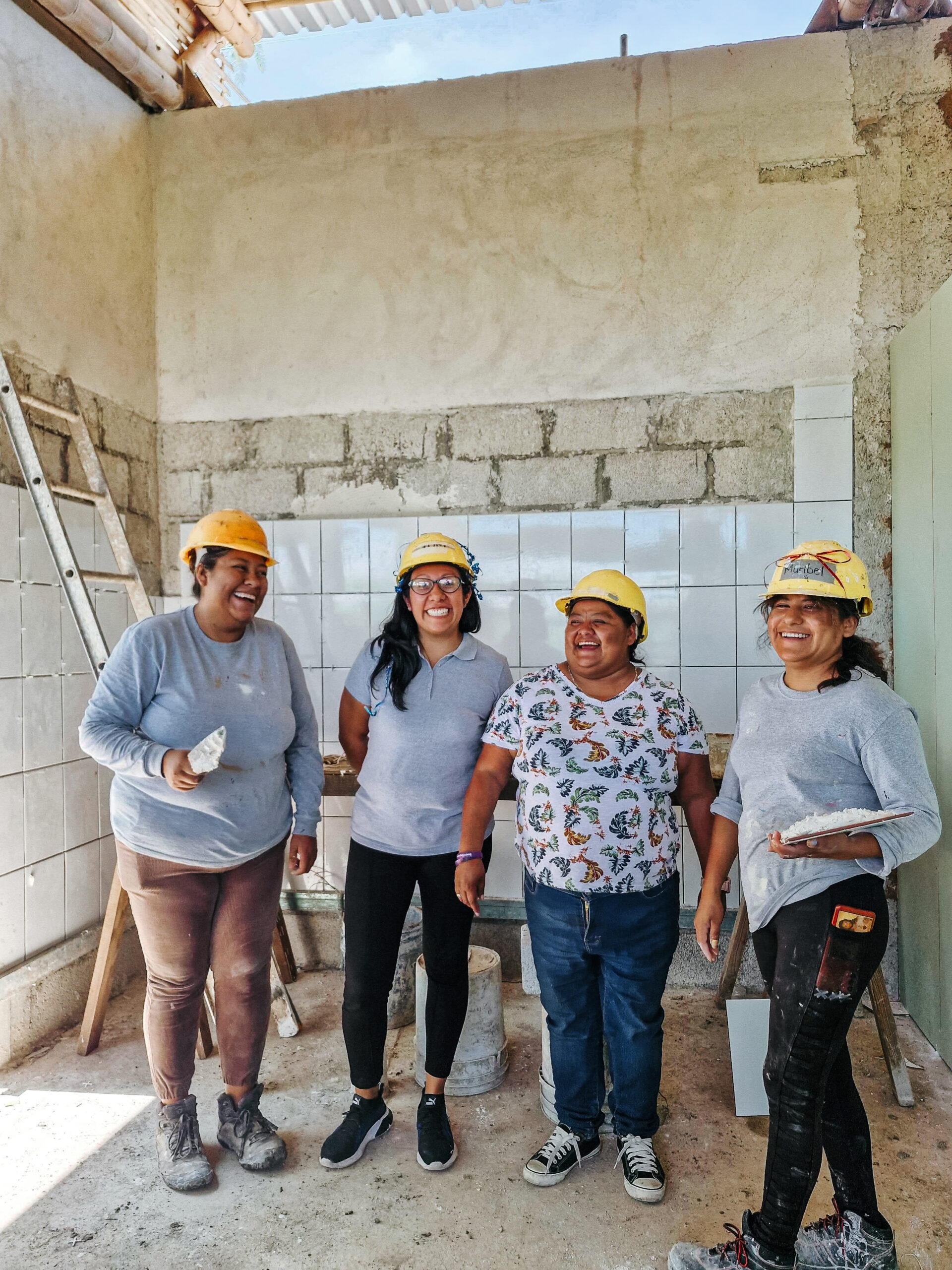
Then we act. Women architects, engineers, project managers, community leaders, and other women in leadership roles are part of creating these spaces. That matters too.

Because the physical design of a school can either reinforce inequality or help challenge it.
- Safe, private, functional bathrooms matter.
- Clean water matters.
- Handwashing stations matter.
- Spaces where girls can learn about menstruation without shame matter.
- Spaces where children can talk about their emotions and learn tools for coping matter.
That is mental health. That is hygiene. That is safety.
- And then we create opportunities.
- We create opportunities for women to learn skills that have traditionally been overlooked or reserved for men.
- We create opportunities for girls to see women building.
- We create opportunities for communities to talk openly about menstruation, mental health, safety, and disaster preparedness.
- And we create opportunities for women and girls to recognize themselves as leaders.
Because sometimes the most powerful thing a girl can see is another woman doing something she had never imagined herself doing.
Water is a women’s health issue.
One of the most tangible examples of this is water.
All Hands and Hearts is committed to ensuring that the schools we work with have access to safe water, sanitation, and hygiene infrastructure.
Of course, water is for everyone.
But we know that the absence of safe, private, hygienic spaces can have particularly significant consequences for girls. In Mexico, 31% of girls and adolescents under 15 report having missed school during their period. That means the absence of something as basic as water, sanitation, privacy, or menstrual supplies can become an educational barrier—a reason NOT to go to school, and ultimately a gender equity issue
So when we install water systems, rainwater harvesting, handwashing stations, or improve sanitation, we are not simply improving infrastructure.
- We are removing barriers to education.
- We are creating healthier and more dignified environments for girls to learn.
- And we are helping create the conditions in which girls can stay in school, build confidence, and eventually become the women shaping their own communities.
And disasters make this even more important.
When a disaster happens, inequalities that already exist can become even more pronounced. Disasters do not affect everyone equally. Existing gender inequalities can become more pronounced during and after a crisis, leaving women and girls facing greater risks to their health, safety, livelihoods and recovery.
That is why building resilience has to include a gender lens from the beginning—not after the disaster happens.
Women and girls can face increased risks to their safety, health, dignity, and mental wellbeing. That is why our approach also includes mental health and psychosocial support, as well as training that helps communities prepare for and respond to disasters. We want girls and women to have tools to protect themselves, understand their emotions, recognize risks, and support one another.
But we also want boys, fathers, and other men in the community to be part of that conversation. Because gender equity cannot be achieved by separating ourselves into two sides.
It happens when we change the way an entire community thinks about safety, respect, health, leadership, and opportunity.
This is what gender equity looks like to me.
- It is not one workshop.
- It is not one statistic.
- It is not one woman sitting at a decision-making table.
It is the accumulation of small, intentional choices made again and again.
- Who gets asked for their opinion.
- Who gets listened to.
- Who gets to build.
- Who gets to lead.
- Who gets access to water.
- Who gets a safe bathroom.
- Who gets to feel comfortable in their own school.
- Who gets to see someone like themselves making decisions.
And who grows up believing: I deserve to be here.
That is why I was so happy to say yes to that invitation.
Because maybe rebuilding schools isn’t traditionally called women’s health work. But when we build spaces where girls are safer, healthier, more confident, more included, and more able to participate in their communities, I believe we are contributing to women’s health in one of its most fundamental forms. We are helping build the conditions for healthier women, healthier girls, and healthier communities to grow.
And I am honored to be part of that work.

Support Long-Term Recovery in Venezuela
Rebuilding after a disaster doesn’t happen overnight, but every bit of support helps families take the next step forward.
Thank you for your support.

